Flexo vs gravure printing: which press for your flexible packaging?
Flexo and gravure are the two main ways to print flexible packaging. Flexo prints from a raised image on a flexible plate or sleeve, so job changes are lighter and quicker. Gravure prints from cells engraved into a metal cylinder, which costs more per job but holds colour and detail most consistently over long runs.
Most converters who ask us for one press are also weighing the other. The right choice depends less on which process is better and more on your order book: how long your runs are, how often you change jobs, and what your brand-owner customers expect from the print.
How do flexo and gravure printing work?
Flexo: a raised image on a flexible plate
In flexography, the image stands up from a flexible photopolymer plate or sleeve. An engraved anilox roller meters the ink, a doctor blade wipes it level, and the anilox inks the raised image, which then prints onto the web.
For flexible packaging, most film is printed on a central-impression (CI) press. Every colour deck sits around one large drum, so all colours register against the same surface. Flexo also prints paper bags and sacks and woven polypropylene, often in line with the machine that makes the bag.
Gravure: an image engraved into a cylinder
In rotogravure, the image is engraved into the surface of a metal cylinder as thousands of tiny cells. The cylinder picks up ink, a doctor blade wipes the surface clean, and the web is pressed against the cylinder to draw ink out of the cells. Each colour has its own print unit and dryer.
The engraved cylinder is the key difference. It holds its image over a very long run, but every job needs its own set of cylinders, one per colour, made before the press can run.
Flexo vs gravure at a glance
| Consideration | Flexo | Gravure |
|---|---|---|
| Image carrier | Photopolymer plates or sleeves | Engraved metal cylinders |
| Best suited to | Short-to-medium runs, frequent job changes | Long, repeating runs |
| Job changeover | Lighter and faster: plates or sleeves | Heavier: a full set of cylinders |
| Consistency over a long run | Good | Highest |
| Main recurring cost | Plates, sleeves and anilox rollers | Cylinders |
| Typical substrates | Film, laminates, paper, woven PP | Film, foil, paper, laminates |
| Press layout for film | Central impression (one drum) | One print unit per colour |

Which process suits your work?
Five questions usually settle it.
How long are your runs?
Gravure cylinders cost more to make than flexo plates, and that cost is earned back over length. Long, repeating runs favour gravure. An order book full of short jobs usually favours flexo.
How often do you change jobs?
Every gravure job change means swapping a full set of cylinders. Flexo changes lighter plates or sleeves, and modern CI presses set impression and register automatically. If you change jobs several times a shift, flexo usually fits better.
What print quality does the brand owner expect?
Gravure holds fine detail, smooth gradients and solid colour consistently over a long run. Modern CI flexo has closed much of that gap, so ask to compare printed samples of your own artwork on both.
What substrate are you printing?
Both print film, paper and laminates. Gravure is also strong on foil. Flexo extends to paper bags, sacks and woven polypropylene. On thin, stretch-sensitive films such as PE, the deciding factor is how the press controls web tension and register.
Where will your money go?
With gravure, much of the running cost sits in cylinders rather than the press. With flexo, more of it sits in plates, sleeves and anilox rollers. Compare the whole cost of running each process on your real job mix, not just the machine.
Rule of thumb: many short jobs and frequent changes point to flexo. Long, repeating runs with the highest consistency point to gravure. Some converters run both.

Which Windmöller & Hölscher presses cover each process?
K Group is the authorized agent in Pakistan for Windmöller & Hölscher (W&H), which builds both CI flexo and rotogravure presses for flexible packaging. Figures are W&H's published maximums; each press is configured for the project.
| Press | Process | Decks | Print width | Speed | W&H positioning |
|---|---|---|---|---|---|
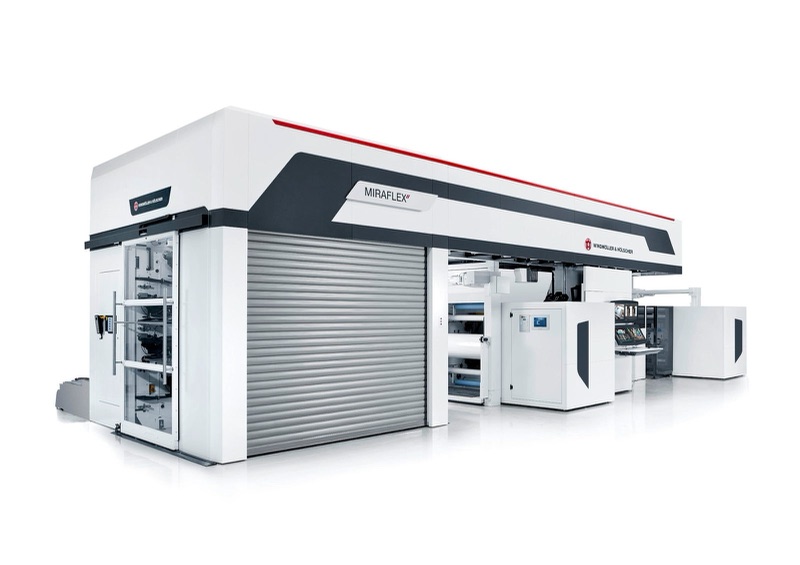
| MIRAFLEX II | CI flexo | 8 / 10 | up to 1,450 mm | up to 600 m/min | Best-selling flexo press worldwide for all flexible packaging applications; 800+ in 90+ countries |
| ONEFLEX | CI flexo | 8 or 10 | 1,000–1,650 mm | up to 600 m/min | New modular, configurable and expandable platform |
| ALPHAFLEX | CI flexo | 8 | up to 1,270 mm | 500 m/min | Compact entry-level CI flexo press |
| HELIOSTAR II S | Rotogravure | max. 14 | up to 1,600 mm | up to 600 m/min | Premium press for highest output and sensitive substrates such as PE |
| HELIOSTAR II A | Rotogravure | max. 14 | up to 1,300 mm | up to 500 m/min | Easy-to-use, cost-efficient press for standard flexible packaging |
Source: Windmöller & Hölscher product pages and product information.
W&H also builds the VISTAFLEX II (fully automated wide-web CI flexo) and NOVOFLEX II (its strongest CI flexo press). Compare all of them on our flexo printing machines and rotogravure printing machines pages.
For paper bags and sacks, see Garant LINAFLEX; for PP woven bags, Botheven flexo presses. Both are on the flexo page.
Frequently asked questions
What is the main difference between flexo and gravure printing?
Flexo prints from a raised image on a flexible plate or sleeve. Gravure prints from cells engraved into a metal cylinder. Flexo changes jobs faster and suits shorter runs; gravure holds colour most consistently over long, repeating runs.
Is gravure better quality than flexo?
Gravure holds fine detail, gradients and solid colour very consistently over a long run. Modern CI flexo presses print high-quality flexible packaging too, so the better choice depends on your artwork, run length and customer expectations. Compare printed samples of your own job.
Which is cheaper, flexo or gravure?
It depends on run length. Gravure cylinders cost more to make than flexo plates, and that cost is spread over the run. On short runs flexo usually costs less per job; on long, repeating runs gravure can work out cheaper.
Can flexo print on PE film?
Yes. CI flexo presses print polyethylene film, laminates and paper for flexible packaging. Gravure prints PE too; W&H's HELIOSTAR II S is designed with register control for sensitive substrates such as PE.
What is a CI flexo press?
A central-impression (CI) flexo press arranges all its colour decks around one large impression drum. The web stays on the drum through every colour, which keeps register tight on stretchy films.
Does K Group supply both flexo and gravure presses in Pakistan?
Yes. K Group is the authorized agent in Pakistan for Windmöller & Hölscher CI flexo presses and HELIOSTAR rotogravure presses.
Sources
- Windmöller & Hölscher, printing presses
- Windmöller & Hölscher, MIRAFLEX II
- Windmöller & Hölscher, ALPHAFLEX
- Windmöller & Hölscher, HELIOSTAR II S
- Windmöller & Hölscher, HELIOSTAR II A
- Windmöller & Hölscher, ONEFLEX product information (see our ONEFLEX guide)