Slitting Machines & Slitter Rewinders in Pakistan
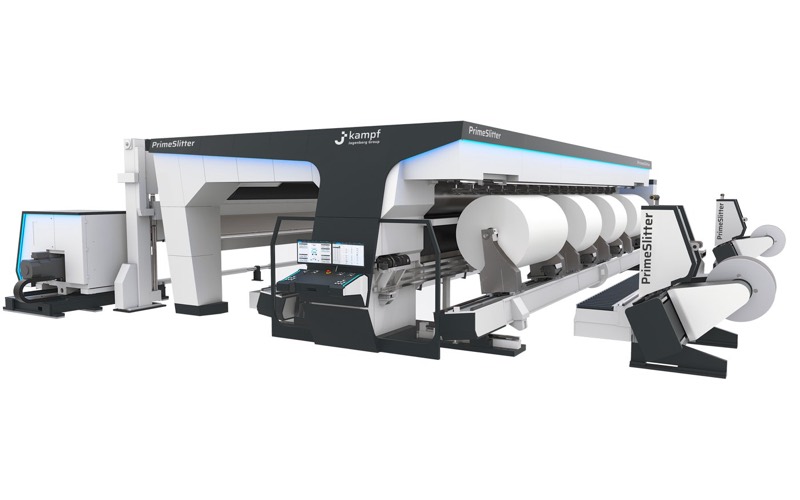
A slitting machine, also called a slitter rewinder or slitter machine, cuts a wide roll of film into narrower rolls and rewinds them at the widths the next process or customer needs. K Group is the authorized agent in Pakistan for Kampf slitter rewinders for film, laminates and refined packaging papers, including BOPP, BOPET and CPP.
How to choose a slitting machine
- Primary slitting at the end of a BOPP or BOPET film line, or capacitor and optical-grade films: PrimeSlitter.
- Commodity films, including cast, blown and calendered films, and, on the SilverLine, secondary slitting of biax films: ProSlitter.
- Converters slitting films, refined papers and laminates in duplex or dual-turret format, up to 2,250 mm material width: ConSlitter.
- Compact duplex or turret slitting, up to 1,750 mm material width: TitanSlitter.
What is a slitting machine (slitter rewinder)?

This page covers slitter rewinders for flexible packaging film, laminates and refined papers. It does not cover steel or metal coil slitting, paper-mill or label slitting, or tape slitting.
A slitting machine, or slitter rewinder, unwinds a wide parent roll, cuts the moving web lengthwise into narrower strips with a set of knives, and rewinds each strip onto its own core as a finished roll. It turns the full-width output of a film line, printing press or laminator into the roll widths the next process needs.
Film producers need one at the end of the line. A BOPP, BOPET or cast film line makes parent rolls much wider than any customer uses, and the slitter cuts them into the widths that are sold or sent on for converting.
Converters and flexible packaging printers need one after printing and lamination. A printed or laminated web usually carries several lanes side by side, and the slitter separates them into finished reels at the width and roll size the packing line has specified.
Primary vs secondary slitting
Primary vs secondary at a glance
| Consideration | Primary slitter | Secondary slitter |
|---|---|---|
| Where it sits in the line | At the end of the film line, straight after extrusion | Downstream, after printing, lamination or storage |
| Input roll | The full-width parent roll from the film line | Primary-slit rolls, or printed and laminated reels |
| Output | Large rolls for sale or further processing | Finished rolls at the width and diameter the customer ordered |
| Typical width class | Widest machines, matched to the film line | Narrower machines, matched to converting widths |
| Typical user | Film producers running BOPP, BOPET, cast or blown film lines | Converters, film traders and flexible packaging printers |
| Kampf machine | PrimeSlitter BlackLine; ProSlitter SilverLine for cast, blown and calendered films | PrimeSlitter SilverLine; ProSlitter SilverLine for biax films |
For converters running many short orders, a compact duplex or turret slitter rewinder is often the better fit. The Kampf ConSlitter and TitanSlitter both come in duplex and turret formats: a duplex machine rewinds the strips on two rewind shafts, while a turret machine swaps to a fresh set of shafts so the next set of reels can start while the finished ones are unloaded. Both handle films, refined papers and laminates on a compact footprint.
Kampf slitter rewinders available in Pakistan
Four Kampf series, from wide primary slitters for film producers to compact converting slitters.

PrimeSlitter
Kampf — primary & secondaryPrimary and secondary film slitting for BOPP, BOPET, BOPE, CPP, BOPA, PLA, metallized and laminated films, and capacitor and optical-grade films.
View details →
ProSlitter
Kampf — commodity filmsStation-type slitting of commodity films: BOPP, BOPET, BOPE, BOPA, CPP, PLA and PS, cast, blown and calendered films, metallized films and laminates.
View details →
ConSlitter
Kampf — duplex & dual turretCompact duplex and dual-turret slitting of films, refined papers and laminates, including coated, specialty and sensitive materials.
View details →
TitanSlitter
Kampf — duplex & turretCompact duplex and turret slitting of films, refined papers and laminates for flexible packaging.
View details →Which slitting machine is right for you?
Five questions decide the machine, and we ask all five before quoting.
What are you slitting? BOPP, BOPET, CPP, metallized film, laminates and refined papers each behave differently at the knife and on the rewind. The material decides which cut gives a clean edge — razor blade, shear or burst — and how carefully web tension has to be controlled.
Primary or secondary? Are you cutting full-width parent rolls straight off a film line, or finished rolls for customers after printing and lamination? That one answer narrows the choice to a family of machines.
What working width and parent-roll size? The working width should match the line or press feeding the slitter, and the unwind has to take the diameter and weight of the parent rolls you actually produce. Check the finished roll sizes your customers ask for at the same time.
What speed, and how often do you change rolls? A fast slitter that stops often for roll changes can produce less than a slower one that changes quickly. Long runs of one width reward speed; many short orders reward duplex or turret formats and short changeovers.
How much automation? Automatic knife positioning, roll handling such as core loading and finished-roll push-off, and a data connection to your production system all cut setup time and errors. Whether they pay depends on how many job changes you make.
Slitting machine price and availability in Pakistan
We do not publish prices, because every slitter rewinder is configured for the project and is not a catalogue item — two converters asking for “a slitting machine” can be quoted very differently. What we can do is be clear about what moves the number, so you can size a budget before asking.
Working width scales almost everything: wider knife shafts, rollers, frames and rewind stations, and heavier rolls to handle.
Speed class matters because a faster slitter needs stronger drives, tighter web-tension control and better roll handling to keep up. Buying speed your work will never use costs money twice.
Primary or secondary sets the machine class. A primary slitter matched to a film line is a larger investment than a secondary slitter sized for converting widths.
Unwind and rewind configuration — duplex or turret, shaft or shaftless unwind, and how many rewind stations — changes both the price and how much the machine produces between roll changes.
Slitting system follows from your materials: razor blade, shear or burst cut, or a combination, each with its own knife holders and set-up.
Automation and knife positioning add cost and buy back time at every job change. Manual knife setting is cheaper to buy; automatic positioning is faster and more repeatable.
Roll handling and auxiliary equipment are routinely underestimated: parent-roll loading, finished-roll push-off and unloading, core handling, edge-trim removal, and the installation, commissioning and training that bring the slitter into production.
Tell us what you need to slit and we will come back with a specification and a price for it.
Lead time depends on the configuration and on the manufacturer’s build schedule, so we confirm it together with the budget indication rather than promise a standard figure.
Slitting machines: common questions
What is a slitter rewinder machine?
A slitter rewinder is a machine that unwinds a wide parent roll of film, laminate or paper, cuts the moving web lengthwise into narrower strips with a set of knives, and rewinds each strip onto its own core. It is how film producers and converters turn full-width rolls into the finished roll widths and diameters that packing lines and customers use.
What is the difference between primary and secondary slitting?
Primary slitting happens at the end of a film line: the full-width parent roll is cut into large rolls for sale or further processing. Secondary slitting happens later, usually after printing or lamination, and cuts those rolls into the finished widths and diameters the customer has ordered. Primary slitters are the widest machines in the line; secondary slitters are narrower and change jobs more often.
What is the price of a slitting machine in Pakistan?
A slitting machine is not a catalogue item, so there is no fixed price. The price depends on working width, speed class, whether it is a primary or secondary slitter, the unwind and rewind configuration, the slitting system, automation and knife positioning, and roll handling. See what determines the price above, then ask for a budget indication on the machine that fits.
Which films can a Kampf slitter rewinder process?
Across the four series, Kampf slitter rewinders process BOPP, BOPET, BOPE, CPP, BOPA, PLA and PS films, cast, blown and calendered films, metallized films and laminates, with capacitor and optical-grade films on the PrimeSlitter. The ConSlitter and TitanSlitter also slit refined papers. Which machine fits depends on the film and on whether you need primary or secondary slitting.
Who supplies Kampf slitting machines in Pakistan?
K Group is the authorized agent for Kampf in Pakistan. Kampf, part of the Jagenberg Group, is a German specialist in slitting and winding machines for films and flexible packaging. K Group supplies the PrimeSlitter, ProSlitter, ConSlitter and TitanSlitter series and supports them locally with sales consultation, installation and commissioning, service and maintenance, spare parts and operator training.
The brand behind these machines
Kampf — German slitting and winding specialist, part of the Jagenberg Group, building slitter rewinders and winders for converting flexible films and flexible packaging. The PrimeSlitter, ProSlitter, ConSlitter and TitanSlitter series run from wide primary film slitting to compact converting slitters. K Group is the authorized agent for Kampf in Pakistan.
Related equipment
Web inspection
Unilux web inspection strobes
Perforation
Tambula perforation machines · Tambula perforation rollers
Edge-trim handling
Lundberg TrimCutter · Lundberg TrimCompactor
Trim recycling
NGR E:GRAN film edge trim recycling · NGR S:GRAN
Related: extruder machines are the film lines that feed a slitter; flexo printing machines and rotogravure printing machines print the reels a secondary slitter cuts to width, and bag making machines turn the slit reels into bags and pouches.
Enquire about slitting machines
Tell our machinery specialists in Pakistan what you need to slit and we'll get back to you. You can also choose a series above to see its details first.
Speak to a specialist
Fields marked * are required.